
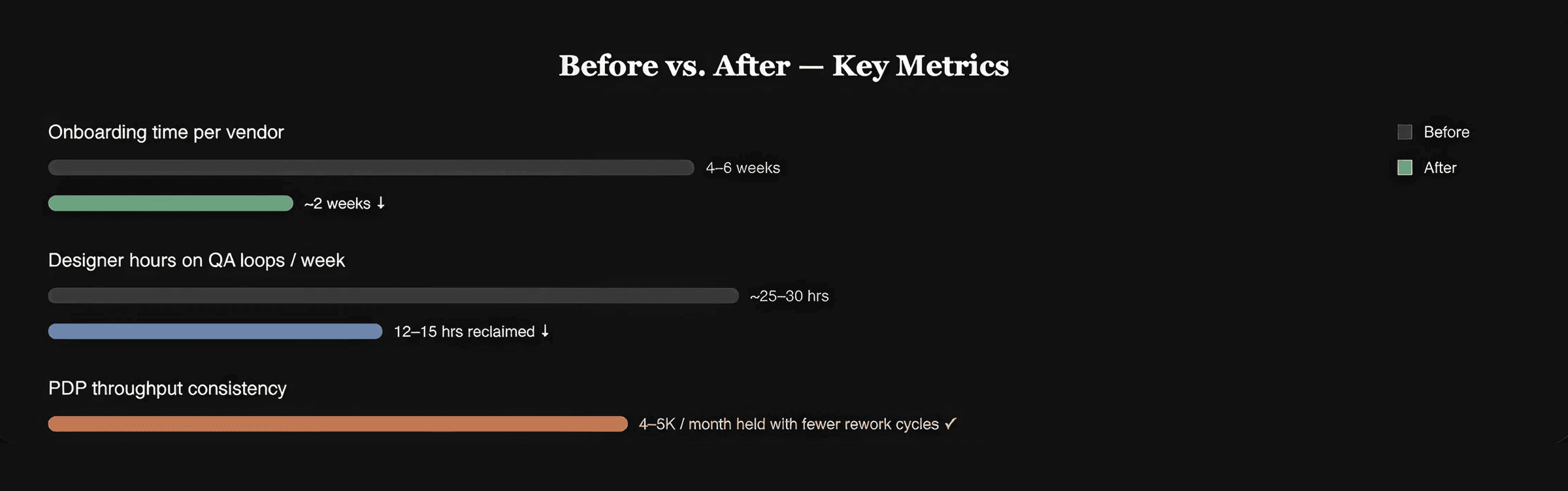
How I built a structured evaluation framework that cut vendor onboarding time in half, protected brand quality at scale, and freed over 12 designer hours a week — without burning the team.
CONTEXT
An AI mandate with no system to execute it
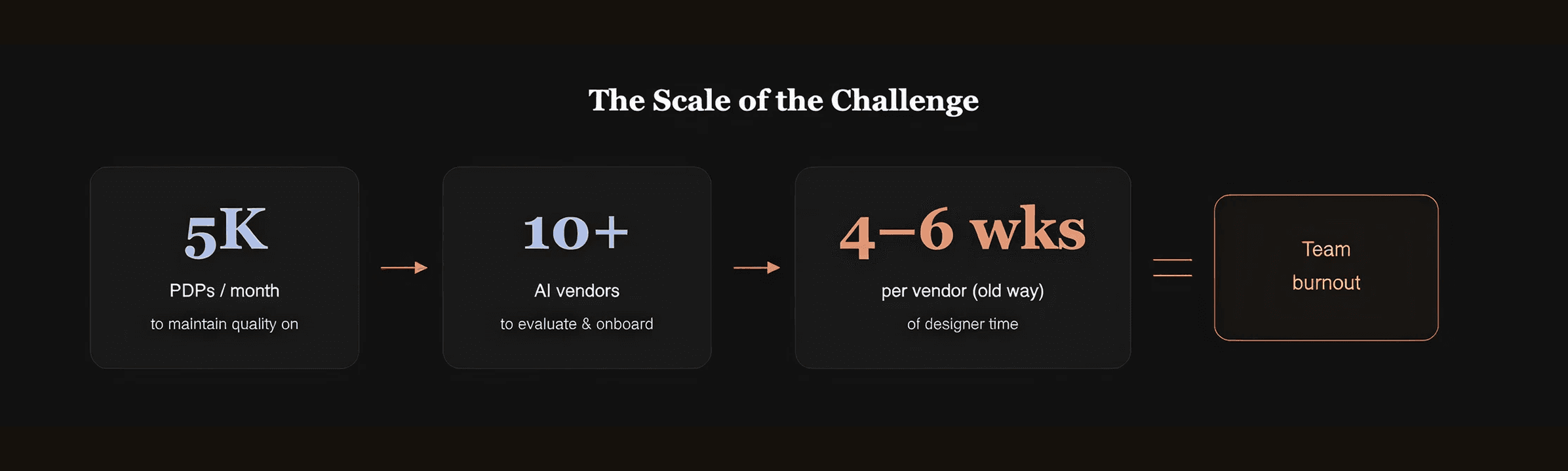
Myntra’s catalog team was shipping 4,000–5,000 PDPs a month, supported by a design org of 100+ people. When AI adoption became a company-wide priority, the mandate landed on us: expand our AI vendor pool to scale visual content production — without dropping Myntra’s brand and craft quality.
DIAGNOSIS
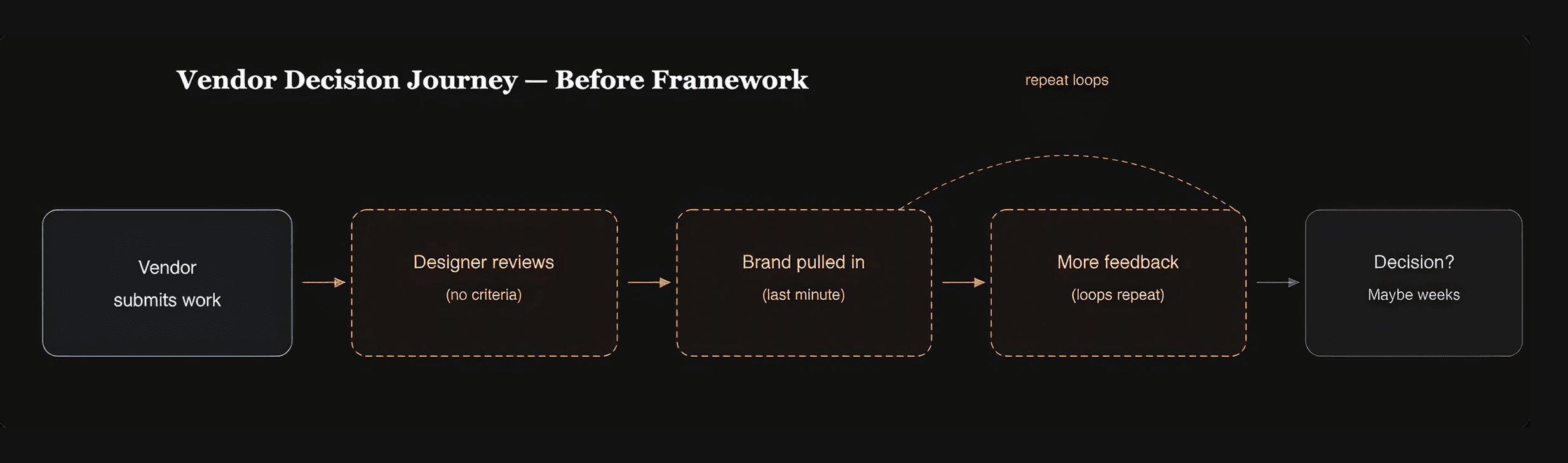
Speed wasn’t the problem. Quality feedback was.
The first instinct on the team was to just start onboarding faster. I pushed back on that. Before designing anything, I spent about a week diagnosing what was actually broken. I had 1:1s with 6 designers, the brand lead, and 2 PMs to understand where the real friction lived.
THREE CRITICAL GAPS
- No standardised delivery framework — no shared understanding of who needed to see design work, at what stage, or in what format.
- Deficit-based performance tracking — the existing system measured only error rates, never what “right” looked like.
- No documentation infrastructure — successful practices lived in individuals’ heads.
THE FRAMEWORK
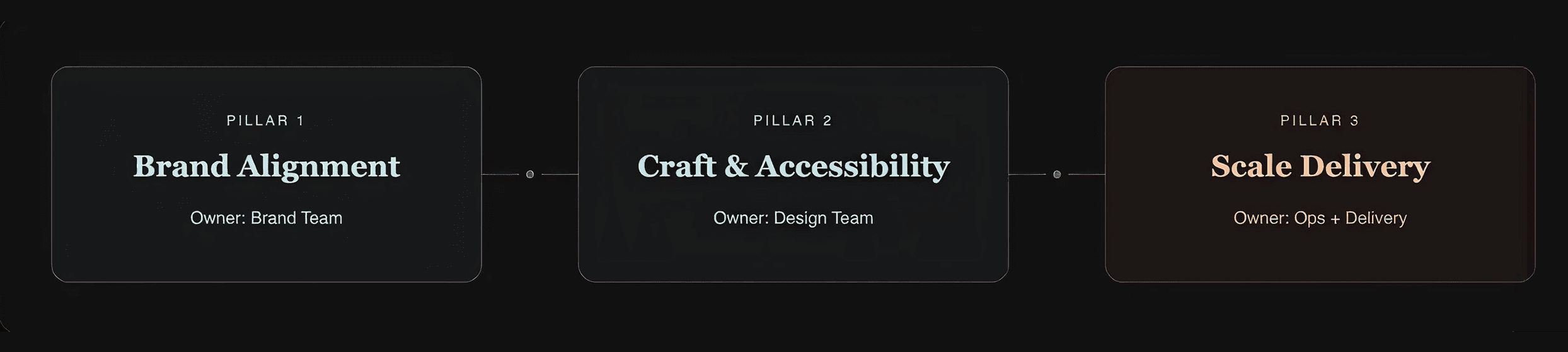
Three pillars, clear owners, no taste debates
Pillar 1
Brand Alignment
Each vendor was scored against a shared rubric built with the Brand team. This removed subjective “taste” debates and replaced them with a clear, co-owned standard.
Pillar 2
Craft & Accessibility
Quality and accessibility as a hard gate, not an average. Fail contrast or alt-text, and you don’t pass craft. This pillar included a V1 to V2 iteration story — vendors had to show they could respond to feedback and improve.

Pillar 3
Scale Delivery
Vendors were evaluated across a 1-month live delivery test. This wasn’t a sandbox — it was real production volume, measuring consistency, turnaround, and communication under actual conditions.
STAKEHOLDER BUY-IN
Bringing the Brand team along
“You’re already making these calls anyway — every time a designer has a brand question, they come to you at the last minute. This framework just writes down what you’re already deciding, once, at the start.”
— Pitch to the Brand team
“Around week three, the brand lead came to me and asked: ‘Can we use this same scorecard for reviewing our in-house content too?’”
IMPACT
REFLECTION
- Framework design matters more than evaluation speed — a clear structure saves more time than a fast but ambiguous process ever could.
- Stakeholder ownership is the difference between a framework that gets adopted and one that gets ignored — the Brand team needed to co-own the rubric, not just approve it.
- The “subjectivity tax” is real — every hour spent debating taste is an hour not spent on actual craft. Shared rubrics eliminate that tax.
- Good frameworks extend themselves — when the brand lead wanted to use the scorecard for in-house reviews, that was the signal it had become infrastructure, not just a project.